AI PRODUCT STRATEGY · Honda Research Institute
Honda Research Institute (HRI) conducts advanced research across AI, robotics, mobility, and neuroscience to identify emerging technologies that shape Honda's long-term innovation strategy
Building an LLM Multi-Agent System for Trend Identification
Defined the product vision, AI workflow, and MVP strategy for a multi-agent trend intelligence platform that transformed fragmented research into structured, evidence-based insights through customer discovery and human-centered AI design
- Role
- AI Product Strategy
- My ownership
- Led customer discovery, product strategy, MVP definition, AI workflow design, and stakeholder alignment — partnering with researchers, AI engineers, and product teams to translate user needs into an AI-powered multi-agent system
THE CHALLENGE
Researchers relied on a fragmented, manual process to identify emerging technology trends across research papers, patents, industry reports, conferences, news, and expert insights.
While AI could summarize information, existing tools lacked transparency and explainability, making researchers hesitant to trust AI-generated recommendations.
The challenge wasn't accessing information. It was helping researchers transform fragmented information into evidence-based decisions.
THE INSIGHT
Customer interviews revealed that researchers didn't struggle to find information. They struggled to determine which signals mattered.
The opportunity wasn't to build another AI search tool. It was to create an AI system that could evaluate, prioritize, and synthesize evidence while keeping researchers in control of the final decision.
THE APPROACH
From evidence to execution.
- 01
Understand the Research Workflow
Interviewed 21 researchers and innovation leaders to map how trends were identified, evaluated, and translated into research recommendations.
- 02
Define the Product Vision
Shifted the product vision from AI-powered search to an AI-assisted decision support system that could evaluate evidence, identify patterns, and generate transparent trend recommendations.
- 03
Design the Multi-Agent Workflow
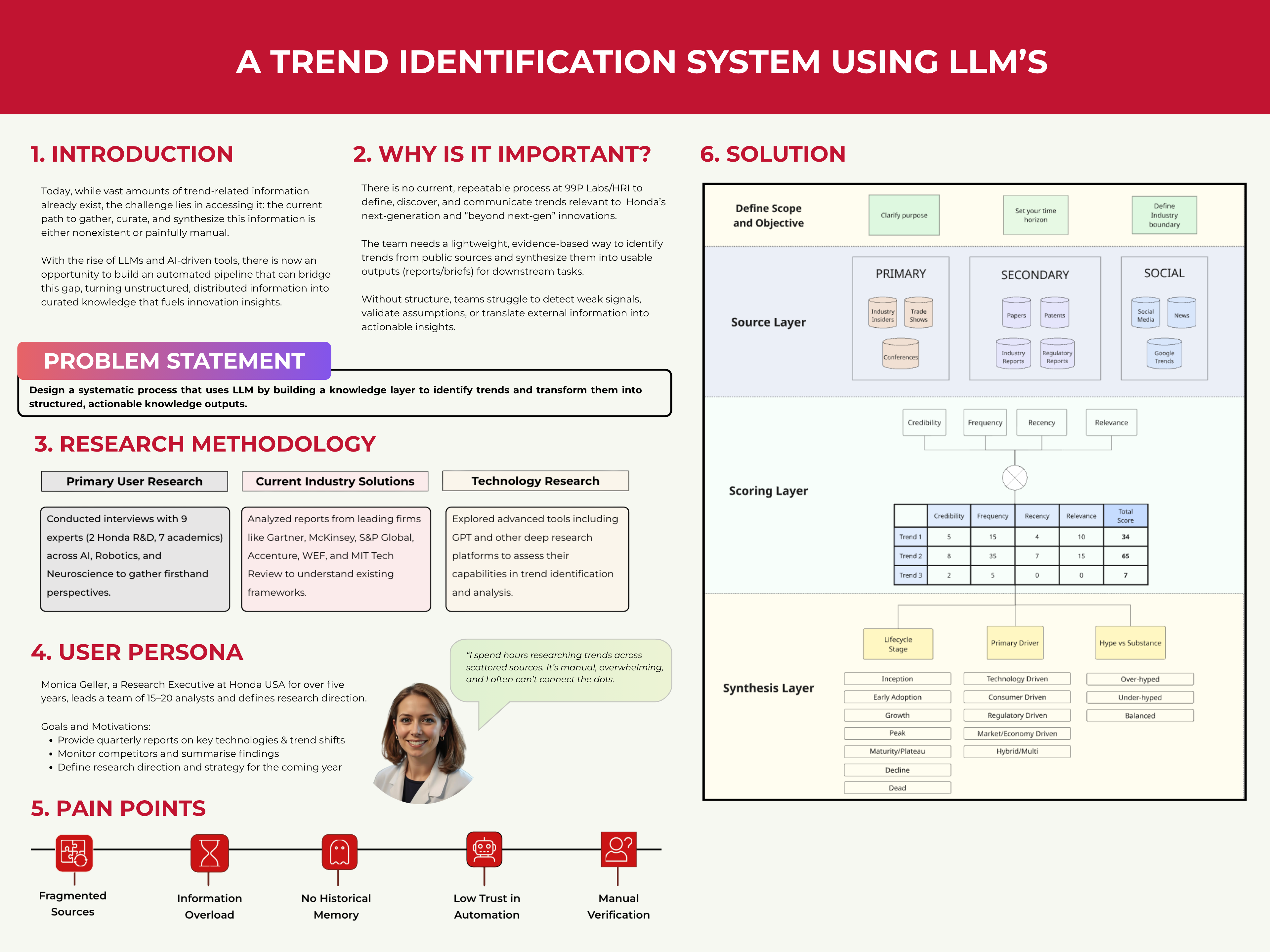
Worked with AI engineers to define a multi-agent architecture where specialized agents collaborated to define research scope, aggregate signals, score evidence quality, and generate explainable trend insights.
- 04
Prioritize the MVP
Balanced customer value, technical feasibility, and trust by prioritizing multi-source signal aggregation, trend clustering, confidence scoring, AI-generated summaries, and human validation workflows.
- 05
Drive Cross-Functional Development
Partnered with researchers and engineering teams throughout development, translating user needs into product requirements, validating workflows, and refining agent outputs through continuous feedback.
LLM MULTI-AGENT SYSTEM
STRATEGIC ARTIFACT / RECONSTRUCTED
A Trend Identification System Using LLMs
THE OUTCOME
The multi-agent system reduced researcher time-to-insight by 30%, unified 8 information sources into a single workflow, supported adoption across 27 researchers and cross-functional stakeholders, and established a scalable framework for evidence-based trend intelligence
Measurement note: Time-to-insight reduction and adoption figures reflect the MVP development and deployment period at Honda Research Institute.
WHAT I CARRY FORWARD
Successful AI products begin with customer problems, not AI capabilities. The most valuable AI systems don't replace human expertise — they enhance it by making complex decisions more transparent, explainable, and actionable